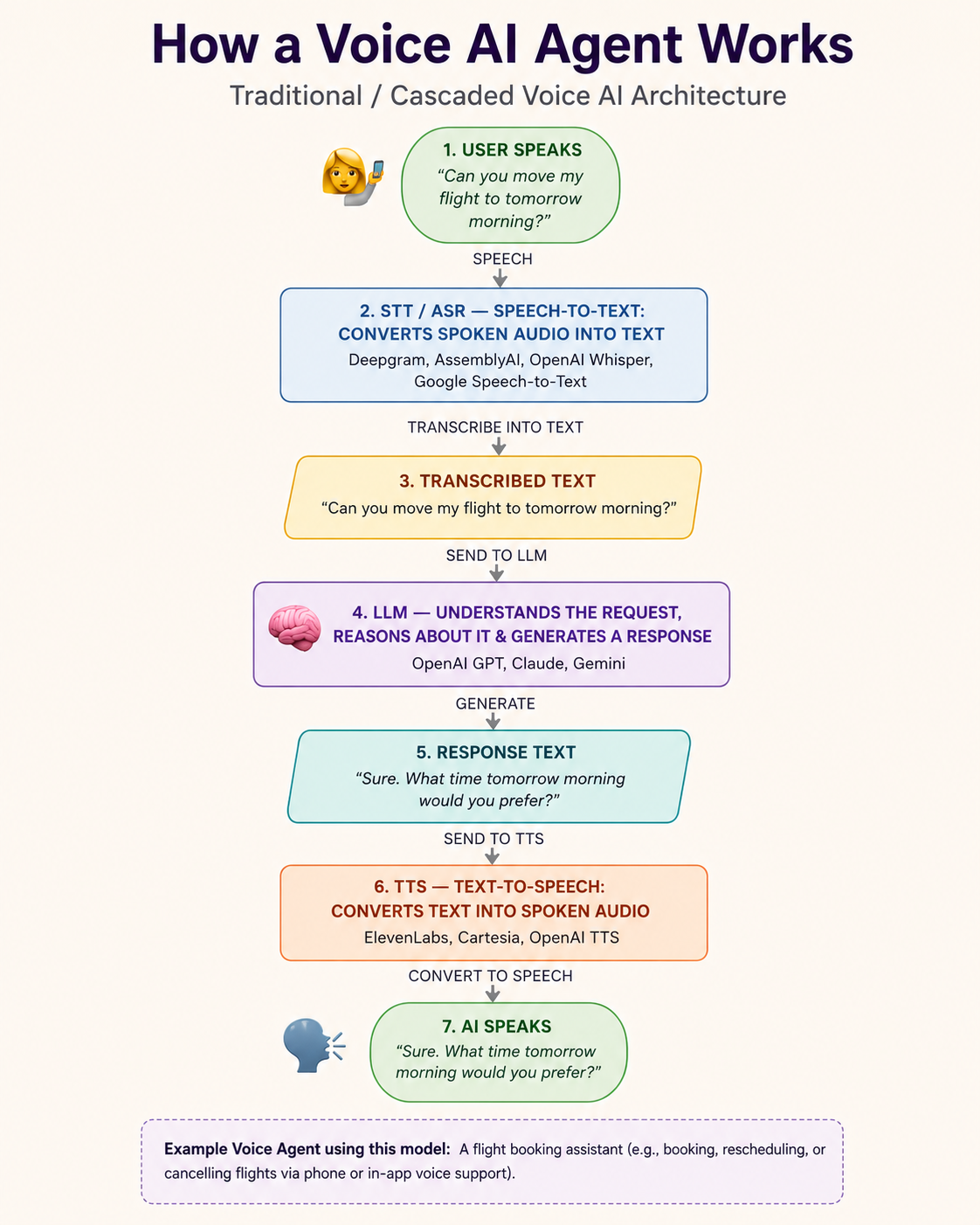
When people hear "voice AI," they usually picture one model that just talks. In practice, most voice agents today are a pipeline of three separate models passing work to each other in sequence:
Speech → STT → Text → LLM → Text → TTS → Speech
This is called a cascaded architecture, because each component's output becomes the next component's input.
The three core components
1. STT (Speech-to-Text / ASR)
Converts spoken audio into text. If a caller says "Can you move my flight to tomorrow morning?", the STT model turns that spoken audio into that same sentence as written text. It is the ear of the system: transforming voice into language a model can reason over. Common providers here are Deepgram, AssemblyAI, OpenAI Whisper, and Google Speech-to-Text.
2. LLM (Large Language Model)
Takes the transcript and does the actual thinking. It understands context and intent, decides how to respond, and can call out to APIs or backend tools to take real-world action, like actually checking flight availability. For the flight example, it might respond: "Sure. What time tomorrow morning would you prefer?" This is where OpenAI GPT, Claude, and Gemini do the reasoning.
3. TTS (Text-to-Speech)
Converts the LLM's text response back into spoken audio, so the caller hears a natural-sounding voice reply instead of reading text. ElevenLabs, Cartesia, and OpenAI TTS are the common picks for this stage.
Why "cascaded" matters
Each stage is a distinct model, often from a distinct provider, wired together in series. That is what makes this a cascade rather than a single end-to-end system: the audio gets fully converted to text, handed to the LLM, and converted back to audio, one stage at a time.
This is also the architecture behind most of the voice agent platforms I've built with and written about, like Vapi and LiveKit. Both orchestrate this same STT → LLM → TTS pipeline; they just differ in how much control they hand you over each stage and how the pieces connect.
Where it's headed
Voice AI is moving past this three-stage cascade toward speech-to-speech models: systems that work directly with audio instead of converting to text and back at every step. That removes the transcription round-trip in the middle, which is where a lot of today's latency and lost nuance (tone, pauses, emotion) come from.
The cascade isn't going away soon. It's well understood, each piece can be swapped independently, and it's easier to debug when something goes wrong. But speech-to-speech is the direction the field is heading, and it's worth understanding the cascade first to see exactly what that shift removes.