My aunt asked me a simple question yesterday:
"What exactly is an open-weight AI model?"
She kept seeing the term in the news about the U.S. considering restrictions on open-weight models and had no idea what it meant.
People working in AI regularly use terms like models, weights and parameters. For someone outside the technology industry, it can be difficult to understand what these terms actually mean.
So I thought I would try to explain it in simple language. I am simplifying a complicated subject here.
1. What Is an AI Model?
ChatGPT, Claude, Gemini, DeepSeek and Kimi are all AI chatbots you can talk to. Each one is powered by an AI model. The chatbot is the part we see. The model is the technology underneath it.
They are trained on large amounts of text, code and other information so they can recognize patterns and generate answers.
For example, when you ask ChatGPT to write an email, it creates a response based on patterns it learned during training. The model does not keep one ready-made answer for every possible question. It uses what it learned to decide what should come next.
That learning is stored inside the model through a very large collection of numerical settings. Most of these settings are called weights. You may also hear the broader word parameters.
When someone says Kimi K3 has 2.8 trillion parameters, it means the model has 2.8 trillion learned numbers that affect how it processes information and produces answers.
It does not mean that it knows 2.8 trillion facts.
That is the "weight" in open weight.
2. Open-Weight and Closed-Weight Models
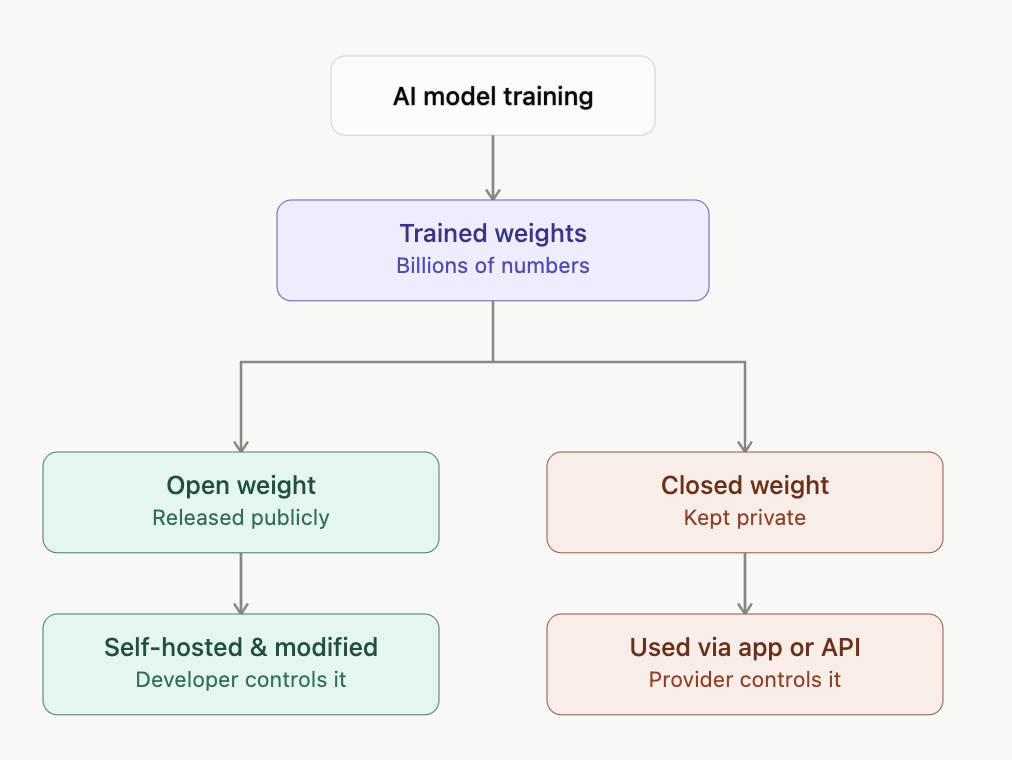
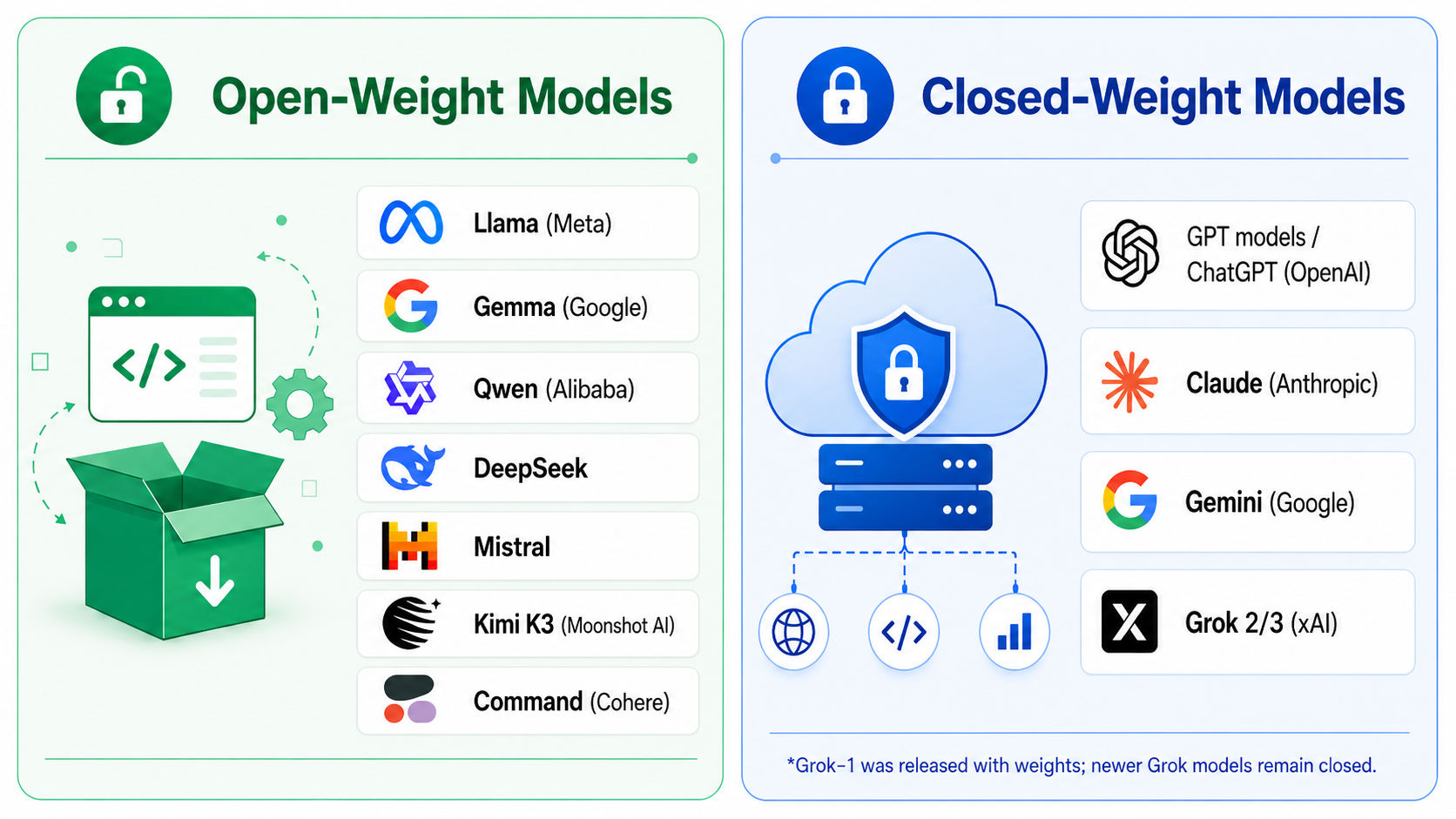
When a company releases the trained weights, developers can download the model and run it on their own computers or servers. That is an open-weight model. Meta's Llama, Google's Gemma, Alibaba's Qwen, DeepSeek, Mistral, Moonshot AI's Kimi and Cohere's Command are familiar examples.
Each model has its own license, so the rules can vary. A developer may be allowed to:
- host the model privately;
- customize it for a specific task;
- connect it to company systems;
- or build it into another product.
Closed-weight models work differently: the companies do not release their weights. Familiar examples include:
- OpenAI's GPT models;
- Anthropic's Claude;
- Google's main Gemini models;
- and xAI's newer Grok models.
(xAI did release Grok-1 with open weights in 2024, but its newer Grok models have stayed closed.)
People can use these models through websites, apps and APIs, but they usually cannot download the complete model and operate it independently.
For a regular user, the difference may feel small. You open ChatGPT or Claude, ask a question and receive an answer. For a company building a product, the difference can be much bigger.
Consider a business creating an AI customer-support system. With a closed model:
- customer questions are sent to the model provider through an API;
- the provider runs the model and sends back an answer;
- the business pays for usage;
- and depends on the provider's prices, rules, availability and future product decisions.
With an open-weight model, the business can choose where the model runs. It may:
- host the model in its own cloud environment;
- customize it;
- and keep more control over how customer information is processed.
That freedom creates more work: the company must manage servers, security, updates, monitoring and safety protections.
Closed models are usually easier to start using. Open-weight models give a company more flexibility and more responsibility.
3. Open Weight and Open Source Are Different
The terms "open weight" and "open source" are often used as if they mean the same thing. They do not.
An open-weight release gives people the trained model. They may be able to:
- download it;
- run it;
- modify it;
- and build products around it.
Open source means something more specific. It gives people the freedom to use, study, modify and share the system.
For an AI model, this usually means providing:
- the model weights;
- the code needed to train and run it;
- suitable licenses;
- and enough information about the training data and process for others to understand and study how it was built.
This does not always mean publishing every original training item. Some data may be private, copyrighted or unavailable for redistribution.
That is a much higher bar than releasing weights. The company may still keep private:
- the original training data;
- the process used to select and clean that data;
- the training code;
- the evaluation methods;
- and many of the decisions that shaped the model.
Researchers may discover that a model performs poorly in a certain language or gives biased answers about a community. Access to the weights lets them observe the problem. Access to the training data and process may help them understand where the problem came from and test possible fixes.
This is why some researchers describe open weights as a form of open distribution. The finished model is available. The complete process behind it may still remain hidden.
Researchers calling for fully open-source AI argue that openness should go further. They want access to the code, training information, evaluation methods, tools and permissions needed to study and reproduce the work.
A simple way to explain the difference:
- Open weights ask, "Can I run and modify this model?"
- Open source also asks, "Can I understand how it was built and verify the process behind it?"
4. What Businesses Gain
Open-weight models can give businesses more control over cost, customization, privacy and deployment:
- A company can run the model on its own infrastructure, customize it for a specific industry or language, and choose where its data is processed.
- For example, a bank could use an open-weight model for financial documents, or a company could connect it to an internal employee handbook so staff can ask questions about policies.
- Open models can also reduce dependence on one provider. If prices change, a model is removed, or an API is updated, the company has more options.
- There are still costs. The business must pay for servers, security, maintenance and technical staff.
- Closed models are easier to start with because the provider manages most of that work.
Open-weight models offer more control. Closed models offer more convenience.
It started with my aunt asking:
"What exactly is an open-weight AI model?"
The simple answer is this:
A company releases the numbers a model learned during training. Other people can then download the model, run it and build products with it.
The company may still keep the training data, code and full development process private.
So open weight is really about who can access the model and how much control the original company keeps.
The next time she sees a headline about restrictions on open-weight models, she will understand what is being restricted.
And the next time someone asks you, you will too.