The Challenge
Design an audio product for Meta
Design an audio product for Meta. As part of a product design exercise, I explored how Meta could make audio more social.
Clarifying questions:
- What kind of audio product ? Are we designing a physical product (headphones, mics, speakers) or a software platform (like Spotify or Clubhouse) that leverages Meta's existing ecosystem (Messenger, Instagram, Groups)?
- Can we say we are building another Spotify for Meta? Or may be a Meta's podcast using their software platform to build connections or communities?
- Why an audio product? What's the goal? Maybe to keep users engaged with the current meta's products?
- Competitors? Spotify, Clubhouse
Problem Framing & Mission Alignment
Meta's mission is to connect people and build communities. While Meta has explored text (Messenger, WhatsApp), images (Instagram), and video/live streaming (Facebook Live), it has not fully tapped into the social potential of audio.
Audio today, be it podcasts, audiobooks, sports commentary, news has become a background to modern life. People listen while cooking, driving, walking pets, commuting, or waiting at appointments. Around 80 million Americans listen to podcasts weekly but almost all of them do it alone. But despite the massive adoption of audio, it remains a lonely, isolated experience.
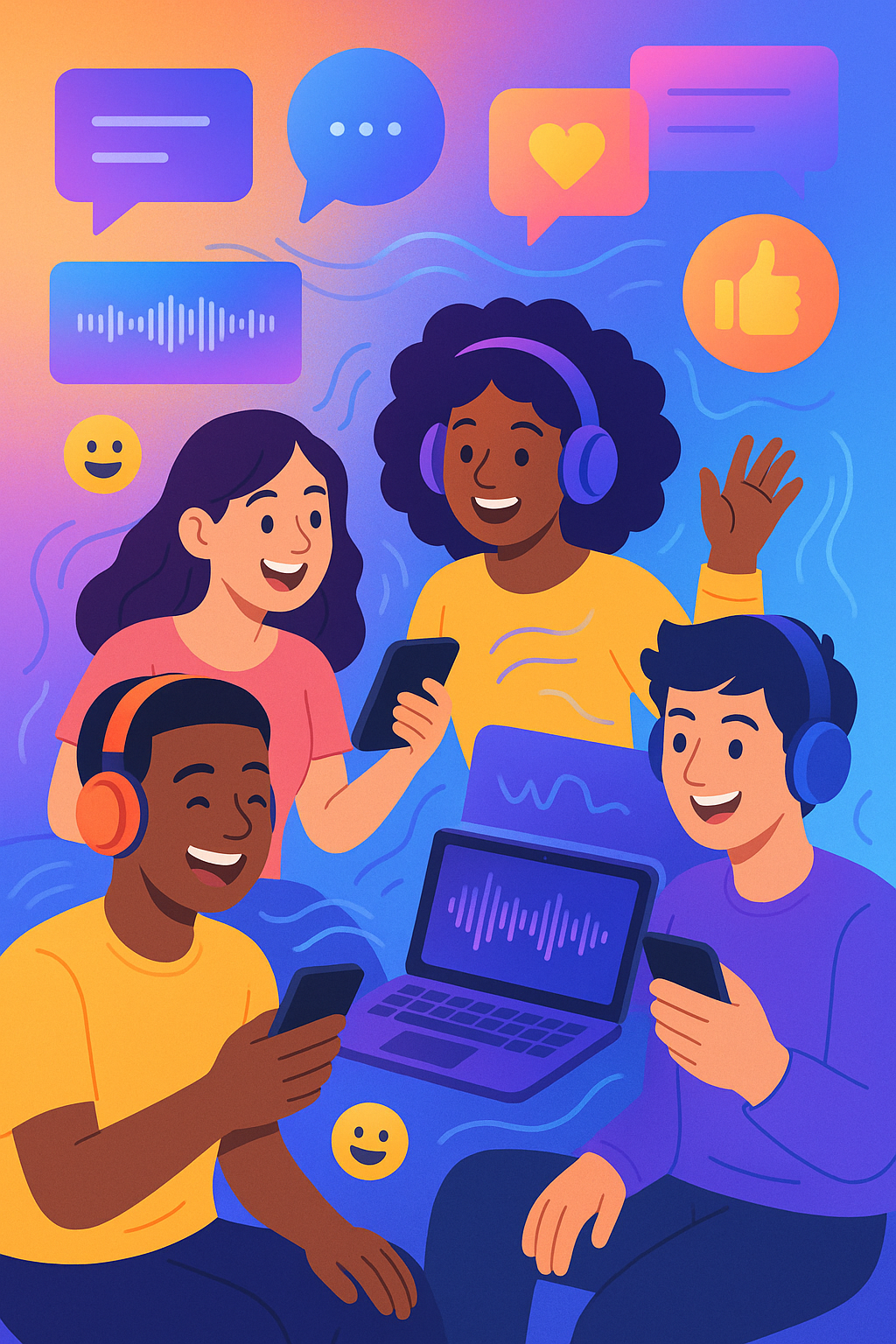
Meta has an opportunity to make audio social, interactive, and community-driven: imagine friends, peers, or families listening to an audio clip, pausing to comment, reacting using emojis and sharing snippets afterward. This aligns perfectly with Meta's mission of turning solitary listening into connection by reacting, commenting and sharing their favourite moments!
GOAL: Our goal is to bring people together and build community by making an audio product that can be interactive, social and connects people through Meta's platform, making it a shared experience rather than an isolated one.
Stakeholders
- Meta internal teams
- Creators & influencers
- Listeners/consumers
- Advertisers/brands
Stakeholders
Content Creators (podcasters, live streamers) - People who want to produce /create high-quality audio using physical audio tools (mics, kits, noise-canceling) or audio softwares like audio cleanup, auto tune and license free background music, to build better content, connect to the entire world, and grow their communities and followers. They want to reach the listeners and spark conversations.
Content Consumers / Listeners – People who listen to the audio (be it books/ news/journals/radio channels/music or podcasts) as it brings them joy, inspiration, motivation, and they want to discover the right content for themselves. Some can be solo listeners and some can be very social who want to share their learnings or experience or takeaways with their friends/peers. This can be done by sharing the entire audio content or snippets of the content helping them build new connections and strengthen the existing ones.
Chosen Stakeholder: Content Consumers / Listeners
Prioritization Criteria: TAM, Feasibility & Mission Alignment
Content Listeners make for a large total addressable market, who listen to audio whenever they are travelling or doing house chores. When people listen to something new or find a new impressive podcaster, they like sharing on social media or with their friends, and this aligns perfectly with Meta's mission of building communities and connecting people. Listeners are the ones sharing, reacting, and bonding over content.
Meta already has the infra (Messenger, Groups, Feed, Reels) built for listener engagement, not pro tools for creators.
Why not content creators? Listeners outnumber creators by a huge margin. Spotify has ~11M creators but 600M+ listeners. Creators are a small supply-side group, while listeners are the demand-side mass market. Creators are too busy with creating new content all the time to stay relevant and grow their subscribers/followers. It's more about monetization than connections or building communities.
Segments
| Segment | Progress they are trying to make |
|---|---|
| Socially-active Time-Optimizers | Functional: They are curious learners who use audio to maximize time and share takeaways efficiently. They want to use their time efficiently, stay active on social media by sharing their favorite audio snippets on social media, and bond with their social network. Emotional: Want to feel accomplished, productive, share their activities/achievements to get positive affirmations, and above all stay connected with people. Social: Want to be seen as knowledgeable, resourceful and driven among their friends/peers/social network. |
| Fan followers | Functional: They believe in and support the influencers, and want to be loyal patrons, by consuming and amplifying their content. Emotional: They feel connected to their influencers with a sense of belonging to the influencer/creator community. Social: Highly active on Meta/Instagram, eager to share their opinions using comments and influence peers. |
| Social Sharers (Show-off) | Functional: They want to show-off on social media (Linkedin, meta, insta) by sharing the newly discovered content. Emotional: It helps them stay active and relevant in their social peer groups. Social: Want to be seen as the first person to discover amazing audio content, who takes pride in sharing it with their social network. |
| Solo Listeners | Functional: They can be curious fellows. They want to use their time efficiently but don't feel the need to share about their interests with the world. They are quiet learners. Emotional: Want to feel happy, productive, and believe in personal growth. Social: Want to be seen as fully aware and focussed. |
| Community Co-Listeners | Functional: They want to listen to audio in real time with friends/family such as sports commentary or live podcasts. Emotional: They want to feel "together" even when they are geographically apart. Social: They want to bond over shared interests & rituals. |
If more than one, pick one
Chosen Segment: Socially-active Time-Optimizers
Prioritization criteria: TAM, Alignment with Meta's Mission, Underserved Need
| Segment | Total Addressable Market | TAM Fit (1–5) | Alignment | Underserved Need (1–5) | Weighted Score |
|---|---|---|---|---|---|
| Socially-active Time-Optimizers | 4 | 5 | 4 | 12 | |
| Fan followers | 2 | 4 | 2 | 8 | |
| Social Sharers (Show-off) | 2 | 2 | 2 | 6 | |
| Solo Listeners | 5 | 1 | 1 | 7 | |
| Community Co-Listeners | 1 | 5 | 1 | 7 |
Rationale for Choosing: #1. Socially-active Time-Optimizers
I will chose #1. Based on our weighted scoring across the Total Addressable Market (TAM), alignment, and underserved need, Socially-active Time-Optimizers scored the highest at 12.
High TAM & Frequency: They are more frequent listeners and spend daily time on podcasts, audiobooks, or news, and would post their learnings, discoveries with friends. They form a large Total Addressable market that can include professionals, students, social media users.
Mission Alignment: They are curious, continuous learners who already spend time on audio and love to share it with their network. Their behavior naturally builds communities because every snippet shared sparks conversations and engagement across Meta's ecosystem. Their need is underserved, there is no platform today that makes audio social, interactive, and community-driven.
Why did you kill your darlings?/ Why not others?
Fan Followers: Loyal to influencers but their behavior is more about supporting creators than building peer-to-peer communities. Smaller TAM and lower frequency of sharing.
- Trade-off: By not choosing them, we lose the chance to tap into highly loyal communities who feel deep emotional bonds with their influencers. This could have given Meta strong stickiness but at a smaller scale.
Social Sharers / Show-offs: They share for staying relevant, not connection and have a low or shallow engagement. Smaller TAM, not genuine community building.
- Trade-off: By not choosing them, we miss out on people who amplify content just to be first. They could have driven quick virality, but it's shallow engagement that doesn't build lasting communities.
Solo Listeners: Big TAM but do not align with the mission. They consume privately, with little intent to connect or share, so they don't fuel Meta's mission.
- Trade-off: By not choosing them, we give up on a very large TAM, but this group isn't naturally social. Their engagement would stay private, which doesn't align with Meta's mission of building communities.
Community Co-Listeners: This segment aligns closely with Meta's mission of connection. Smaller TAM. Co-listening is powerful but synchronous listening requires coordination and time. Many people don't want to schedule audio listening time. Moreover, co-listening is more event-driven, less frequent rather than continuous /consistent engagement.
- Trade-off: By not choosing them, we lose the "together in the moment" magic of synchronous experiences, but their TAM is very small and not frequent enough to sustain broad adoption.
Obstacles
Brainstorm Obstacles
I hate that…
- I cannot retain everything in the podcast, and I hate going through the entire podcast again to find that snippet. I cannot easily capture my favorite snippet by pausing the podcast and then making a list of my favourite snippets at the end of the podcast, something like my takeaways from the podcast, that I can then share with my friend.
- The podcasts being so long, I don't have the bandwidth to listen to them. I wish I could hear the summary of the podcast (like blinkist and headway), and share it with family/friends.
- I cannot find or discover the podcast on topics that I am interested in, and have to spend a lot of time discovering the right ones for me.
- When I listen to a podcast but can't connect it back to my current conversations or social circle. It feels like wasted potential if I can't share it where it's relevant.
- When I feel like writing down the snippet from the podcast, making it my phone screensaver or something to be put on a sticky note for my computer. I hate the 'out of sight out of mind thing'.
Pick one or more obstacles to focus on.
Clearly explain your rationale for picking the obstacle:
Prioritization criteria: Intensity of need & Mission alignment
I will prioritize the obstacle #1. : "I cannot retain everything in the podcast, and I hate going through the entire podcast again to find that snippet. I cannot easily capture my favorite snippet by pausing the podcast and then making a list of my favourite snippets at the end of the podcast, something like my takeaways from the podcast, that I can then share with my friend."
Intensity of need: For Time-Optimizers, this is a constant frustration. They want to show productivity, share insights, and start conversations. Going back through the entire episode just to find one insight is frustrating and time-consuming. It makes them feel like they are wasting time and losing valuable knowledge. They also don't like that they can't easily save or reshare my favorite moments, snippets, jokes, quotes etc. and wish they had a simple way to capture takeaways as they go and revisit them later.
Mission alignment: Sharing takeaways sparks discussion, comments, reactions, this is exactly how Meta builds connections and communities. A single clipped insight can ripple across Messenger groups, Instagram reels, or Facebook feeds, creating conversations that go beyond just the listener.
Underserved: No major platform today has made audio inherently social. Spotify lets you share links, but not personalized snippets with context. This is a white space that Meta can uniquely fill.
For Meta, solving this obstacle transforms audio from a solo consumption habit into a community-driven activity where learning, conversations, and bonding naturally happen.
Solutions
Brainstorm Up to three solutions
Focus on explaining how the user uses the solution rather than the technology
1. Snippet Capture, Editor & Recall
While listening, users can pause and instantly clip audio snippets, tag them as takeaways, and share them with friends or post to social media. Builds conversation and peer learning. They can also use the editor to convert those snippets into text, with inspiring templates, and share with friends via whatsapp,messenger, feed etc. With Snippet Capture, Editor & Recall, Meta makes sure you never lose those moments again.
How it works (user flow):
- While listening, you simply tap once to pause and capture the last 15–30 seconds of audio.
- The snippet gets saved with context (title of the podcast, timestamp, even auto-generated transcript).
- You can tag it, "Motivation", "Funny Moment", so you'll remember why it mattered.
- From here, you can edit them using audio to text features (in-built templates to choose from) and share instantly via Messenger, WhatsApp, or Feed.
- At the end of the podcast, Meta automatically creates a Takeaway Reel: a scrollable feed of your saved snippets, turned into bite-sized cards with audio, text, and even visuals (like Canva-style templates).
- Meta can also nudge you the next day: "Here are your 3 takeaways from yesterday's episode. Do you want to share them?"
2. Smart Discovery Feed
A personalized feed on Meta that curates trending podcast episodes, audiobooks, or news snippets based on what your friends, groups, or professional network are listening to. This can save time hunting for good content, and leverages Meta's social graph to surface audio worth sharing.
How it works:
- The User logs into Meta and sees a short audio "tile" of a trending snippet in their feed.
- They can tap to listen (30–60 sec preview), react, or save the full episode to their playlist.
- Users see which of their friends are also listening or sharing the same snippet, sparking natural discussions in Messenger or Groups.
3. AI-powered Snippet Weekly Journal
An automatic journal of all the snippets you've saved across podcasts/news/books that gets compiled daily or weekly by Meta into a journal. This converts casual listening into a habit and a portfolio of knowledge that reflects productivity and expertise, fueling social sharing.
How it works:
- The user saves snippets while listening.
- Meta generates a short "journal" like your personalized highlights reel with text + audio clips.
- You can publish this journal directly to LinkedIn, Instagram Stories, or Meta Feed to showcase your week's learnings.
Pick one solution
Clearly explain your rationale for picking the solution
Prioritization criteria - Impact on the segment & Feasible, Differentiation
I will choose Snippet Capture & Recall because it directly addresses the frustration of our chosen segment, Socially-active Time-Optimizers.
Impact on the segment: These users are hungry learners who don't just consume content, they share it. Capturing snippets makes them feel productive, resourceful, and proud to showcase their takeaways with peers. They no longer waste time re-listening to long podcasts just to find that one golden nugget. Every snippet becomes a talking point, a social currency that strengthens their personal brand and sparks conversations. This directly fuels Meta's mission of building connections and communities.
Feasibility: Meta already has the core infrastructure, Messenger, WhatsApp, Feed, Reels to make snippet capture and sharing seamless. No need to reinvent the wheel.
Differentiation: Competitors like Spotify or Blinkist focus on content delivery and summaries, but none solve the pain of capturing, organizing, and socially sharing snippets in real time. This makes Meta uniquely positioned to transform audio from a solo habit into a shared, community-driven experience.
Why did you kill your darlings?/ Why not others?
- Smart discovery feed feels more like an algorithmic feed, not a fundamentally new community experience like Snippet Capture.
- Snippet journal helps with recall and sharing, but it's delayed (after listening), not interactive like Snippet Capture.
Success Signals & Metrics
North Star Metric: % of saved snippets that get shared (via Messenger, WhatsApp, or Feed) within 24 hours of capture.
Secondary Metrics:
- Average # of snippets captured per listening session (target: 2+).
- % of snippets that generate at least one reaction/comment from peers (target: 40%+).
- Retention: % of users who capture & share snippets weekly for 4 consecutive weeks (target: 30%+).
Go-to-Market & Scaling Plan
Launch (first 6 months):
- Target socially active professionals and students who already post on Instagram/LinkedIn.
- Incentivize them with discounts/deals for early users.
- Use marketing videos showing people clipping, saving, editing, and sharing snippets — friends reacting, laughing, and commenting.
Grow (6–18 months):
- Highlight top sharers and snippet creators on Meta platforms.
- Partner with popular podcasters who promote the snippet capturing feature and snippet weekly journal during their shows.
Scale (18+ months):
- Launch "Snippet Journals" as a standalone personal knowledge product within the Meta ecosystem.
- Enable co-journals: groups can collaboratively build a shared knowledge journal from the same podcast or event.
- Expand globally, starting with markets where audio adoption is high (e.g., US, India, EU).
Closing Note
By solving the isolation of audio with snippet capture, editing, and recall, Meta transforms passive listening into a social, community-driven experience. Listeners can save key moments, turn them into personalized takeaways, and share them instantly across Messenger, WhatsApp, or Feed. This not only sparks conversations and strengthens connections but also helps people retain what matters most. What was once a solitary activity becomes interactive, memorable, and meaningful, fully aligned with Meta's mission of connecting people and building communities through audio.