
KimWolf caught my attention because it challenges a basic assumption:
Being "behind the router" does not always mean being safe.
Most of us assume that devices inside our home network are protected from the outside internet. A router feels like a wall. The outside world is out there. Our devices are in here.
KimWolf showed why that assumption can break.
At first, it sounds like a familiar cybersecurity story: millions of compromised devices being used to disrupt websites and online services. KimWolf has reportedly spread to more than 2 million devices, and the broader Aisuru-KimWolf ecosystem has been tied to some of the largest DDoS attacks publicly reported.
But the technical flow is what makes this story more interesting. KimWolf was not just attacking devices directly exposed to the internet. It abused residential proxy networks.
This abuse path was investigated by Synthient, a startup that tracks proxy networks and botnet infrastructure.
And to understand why that matters, we first need to understand what residential proxy networks are.
How residential proxy networks work
A residential proxy network lets someone route internet traffic through real consumer devices, like phones, laptops, or TV boxes. In simple terms, it lets someone "borrow" a home internet connection, so websites think the request came from a real household.
That matters because traffic from a home internet connection looks more trustworthy than traffic from a cloud server or data center.
Legitimate businesses use residential proxies for things like:
- Ad verification: "Does my ad actually show up in Tokyo?"
- Price monitoring: "What does this product cost in Germany?"
- Fraud detection: "Does this login look suspicious from this region?"
- Localization testing: "Does the website show the right language, currency, and content?"
- Market research: "How does this service appear to users in different cities?"
In normal use, the flow looks like this:
Customer -> Proxy provider -> Enrolled consumer device -> Target website
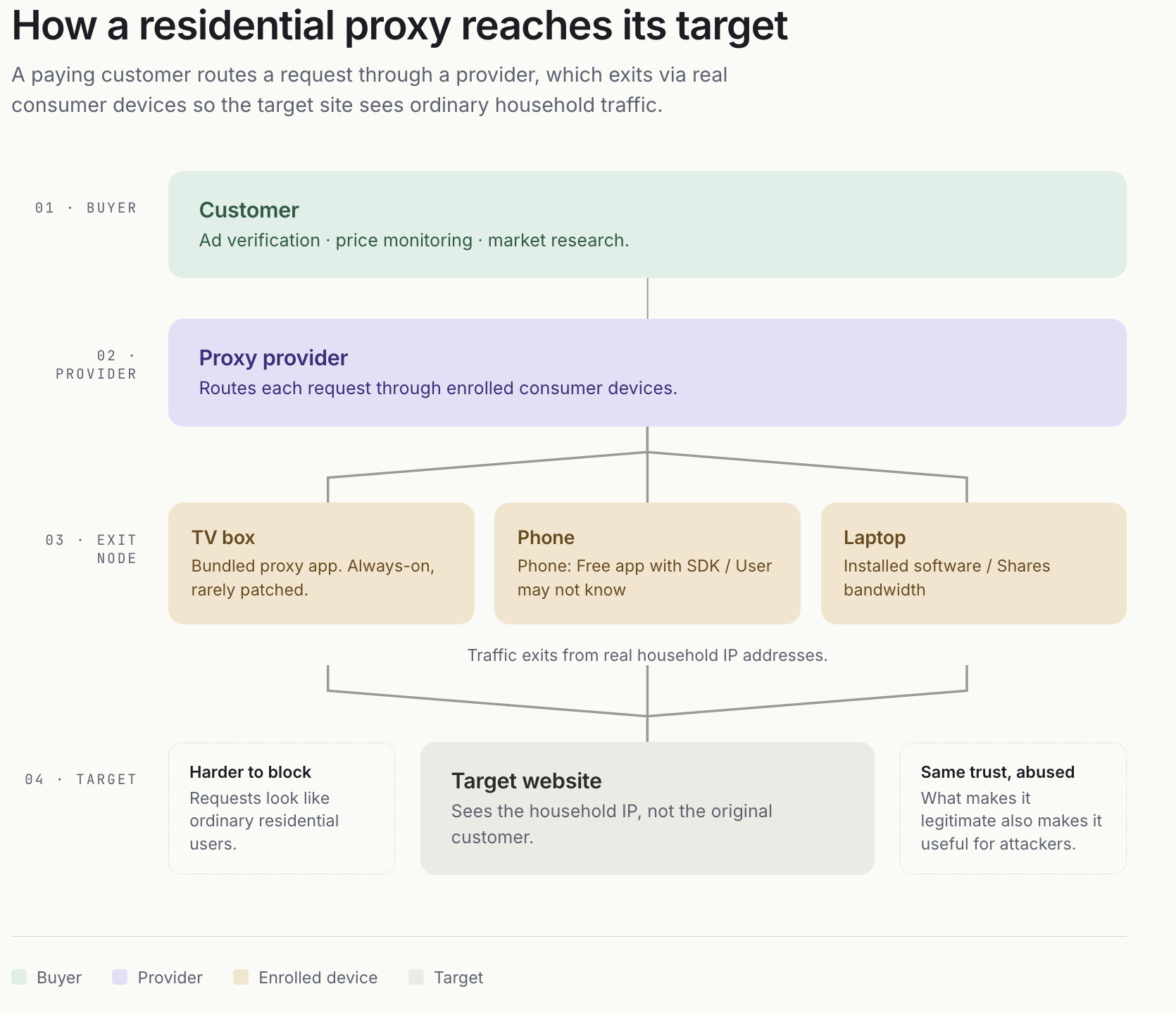
In a residential proxy network, the target website sees the household IP address, not the original customer behind the request.
The proxy provider may pay or incentivize device owners to install software that shares their internet connection. Some users do this knowingly in exchange for a free app or service. But many users do not meaningfully consent. The software may come bundled silently with games, streaming tools, pirated apps, or pre-loaded on cheap Android TV boxes.
That is where the trust problem begins. The traffic looks normal because it comes from a normal household IP address. But the person living in that household may have no idea their connection is being used.
Devices that become proxy endpoints
The most common targets in the KimWolf story were low-cost Android TV boxes and other Android-based devices. These devices are attractive targets because they often have a few things in common:
- They run a full Android-based operating system
- They are usually always on and connected to the internet
- They rarely receive security updates
- Some expose Android Debug Bridge (ADB), especially when poorly configured
ADB is a developer feature used to test and control Android devices, like a maintenance door. On some low-cost Android TV boxes, it may be left open because the device was poorly configured, modified for debugging, or never properly locked down before being sold. Useful for developers, but a wide open entry point for anyone else who finds it.
If ADB is exposed without proper authentication, an attacker may be able to connect to the device, install malware, and turn it into part of a botnet or proxy network.
Beyond TV boxes, researchers have also seen activity involving Android phones, other IoT devices, and devices inside enterprise and government networks. That enterprise angle matters, because KimWolf was not limited to ordinary home networks.
How these devices get infected
These devices usually enter the problem in two ways.
The first is bundled software.
A user installs what looks like a free app, game, or pirated streaming tool. Hidden inside, proxy software may quietly start sharing the device's internet connection with a proxy network. The user may never realize their device has become part of someone else's infrastructure.
The second path is exposed Android debug access.
Android Debug Bridge, or ADB, is a developer tool used to test and control Android devices. In simple terms, it is like a maintenance door for Android devices.
That door is useful for developers.
But if it is left open or poorly secured, attackers can walk through it.
On some low-cost Android TV boxes, that door may be left open because the device was poorly configured, modified for debugging, or never properly locked down before being sold.
Once KimWolf operators had access to one proxy device, they could use that position to look for other Android devices on the same local network with exposed debug access.
If another device responded without proper authentication, malware could be installed on it.
This is what made the attack path especially concerning.
The proxy device was not just sending traffic outward.
It became a bridge to find and infect other devices sitting behind the same router.
What did KimWolf use compromised devices for?
KimWolf was financially motivated. The compromised devices were not just infected and left alone. They became infrastructure that could be reused in different ways.
Some were used to launch DDoS attacks, flooding targets with traffic to knock websites and online services offline. Others were quietly enrolled into residential proxy pools, with their bandwidth and home IP addresses sold or rented to third parties. To the buyer, the traffic looked like it came from a real household. Not a cloud server. A real person.
Researchers also found signs that additional proxy software could be pushed onto the same devices, meaning one compromised TV box could be enrolled in multiple proxy networks at once and monetized several times over.
This was not only a smash-and-grab operation. It looked more like infrastructure: millions of devices quietly extracting value over time, while most device owners had no idea anything was happening.
How KimWolf abused the path inward
Normally, a proxy routes traffic outward to the public internet. KimWolf made this more dangerous by abusing the path inward.
The flow looked more like this:
Attacker -> Residential proxy network -> Compromised endpoint / exit node -> Local network devices
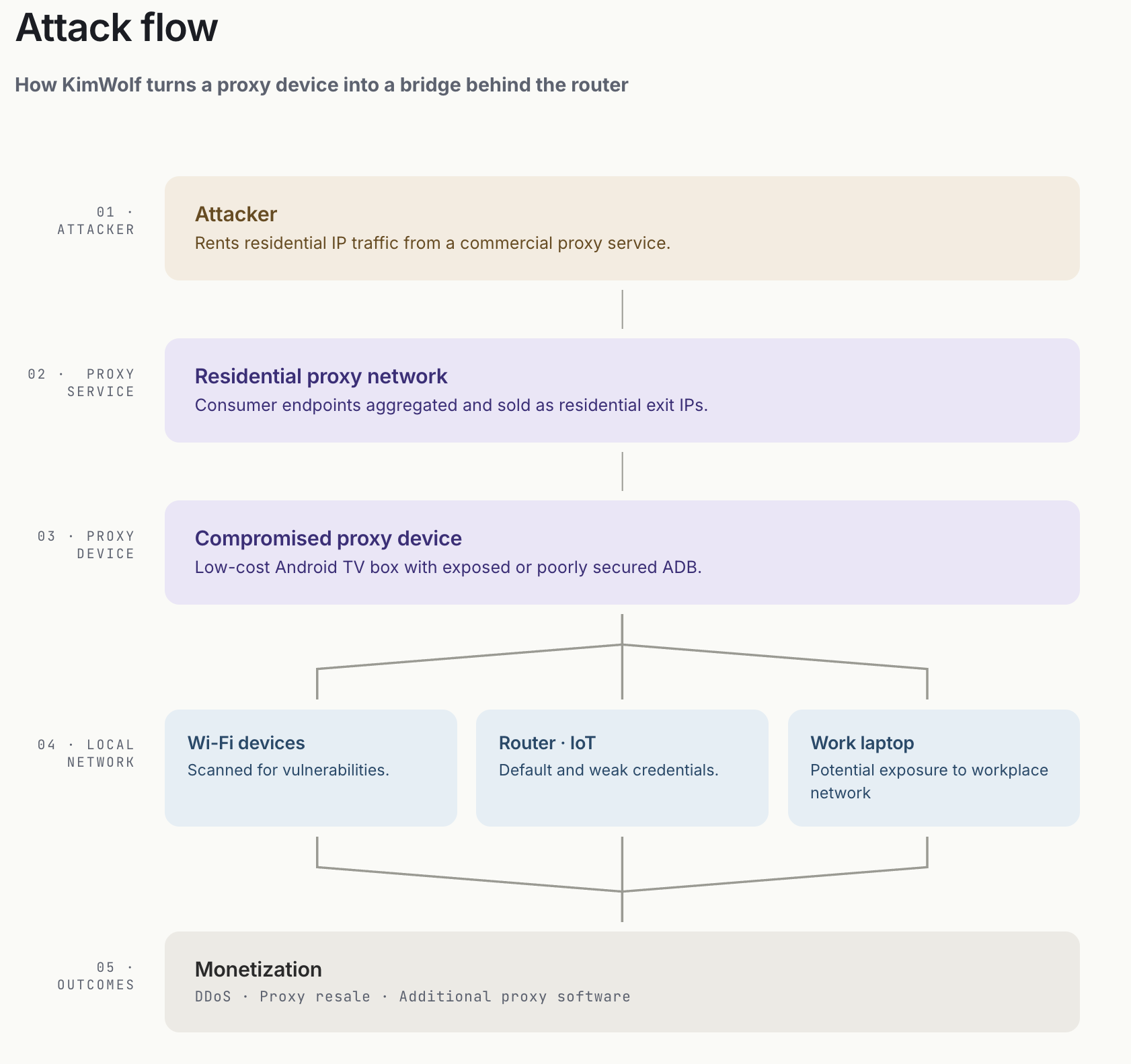
How KimWolf turned a compromised proxy endpoint into a bridge to devices behind the router.
According to reporting and research on KimWolf, IPIDEA's proxy service had a weakness that allowed certain requests to reach internal or local network resources instead of blocking them. That meant an attacker could pay for proxy access, tunnel through the proxy device, and potentially reach other devices on the same home or office network.
This is why KimWolf is such a good example of hidden risk. The attacker did not need to break through the router from the outside. The risky software was already inside.
Why this matters even if you are not running a proxy
Most people will read this and think: "I don't use a residential proxy network, so why should I care?"
That is the wrong question. The better question is: "Could something on my network be acting as a proxy endpoint without me realizing it?"
Because if one infected device is already inside your network, it may create risk for everything around it. One infected device could allow an attacker to:
- Scan other devices on your Wi-Fi
- Look for weak passwords or unpatched firmware
- Relay abusive traffic through your home IP address
- Create a foothold that could expose enterprise or government networks if infected devices are present inside them
Infoblox reported that nearly 25% of its cloud customers had at least one device query a KimWolf-related domain. That does not automatically mean all those networks were fully compromised, but it does show how widely this kind of activity can show up in real environments.
A compromised device does not have to look dramatic. It may not crash. It may not show a warning. It may keep doing the thing the user bought it for. But quietly, in the background, it can become infrastructure for someone else.
The Synthient investigation
The investigation was led by Benjamin Brundage, founder of Synthient, a startup that specializes in tracking proxy networks and botnet infrastructure. His team monitored proxy traffic and analyzed the IPIDEA network directly, tracing how requests moved and whether the path could reach internal network addresses.
That investigation helped make the risk visible. They also published a scanner so people can check whether their network appears to be affected. Their advice for infected TV boxes is blunt: wipe it or throw it away.
The bigger lesson
KimWolf is not just a story about malware. It is a story about trust.
Residential proxy traffic is valuable because it looks normal. It looks like a real home. A real person. A real location. That trust is useful for legitimate businesses. But it is also useful for attackers.
KimWolf did not just exploit vulnerable devices. It exploited the trust we place in "normal" household traffic. And once that trust was weaponized, the router was no longer the wall we thought it was.
The fix is not only patching one proxy provider. The industry needs stronger controls around residential proxy networks: blocking private and internal network ranges by default, verifying consent more clearly, and treating consumer devices as part of the security perimeter.
Trust is an attack surface too.
If risky proxy software is already inside the house, the router is a weaker wall than it seems.