People are calling #HermesAgent an OpenClaw competitor. So I sat down to understand what Hermes actually is and how it works under the hood.
Hermes is the self-improving open-source AI agent from Nous Research, built around memory, reusable skills, and long-running execution.
OpenClaw feels messaging-first. Easy to understand as an agent you can text through WhatsApp, Slack, or Telegram.
Hermes feels more memory-and-skills-first. It is about building context, saving workflows, and improving repeated tasks over time.
The architecture is simple. Here is how it works:
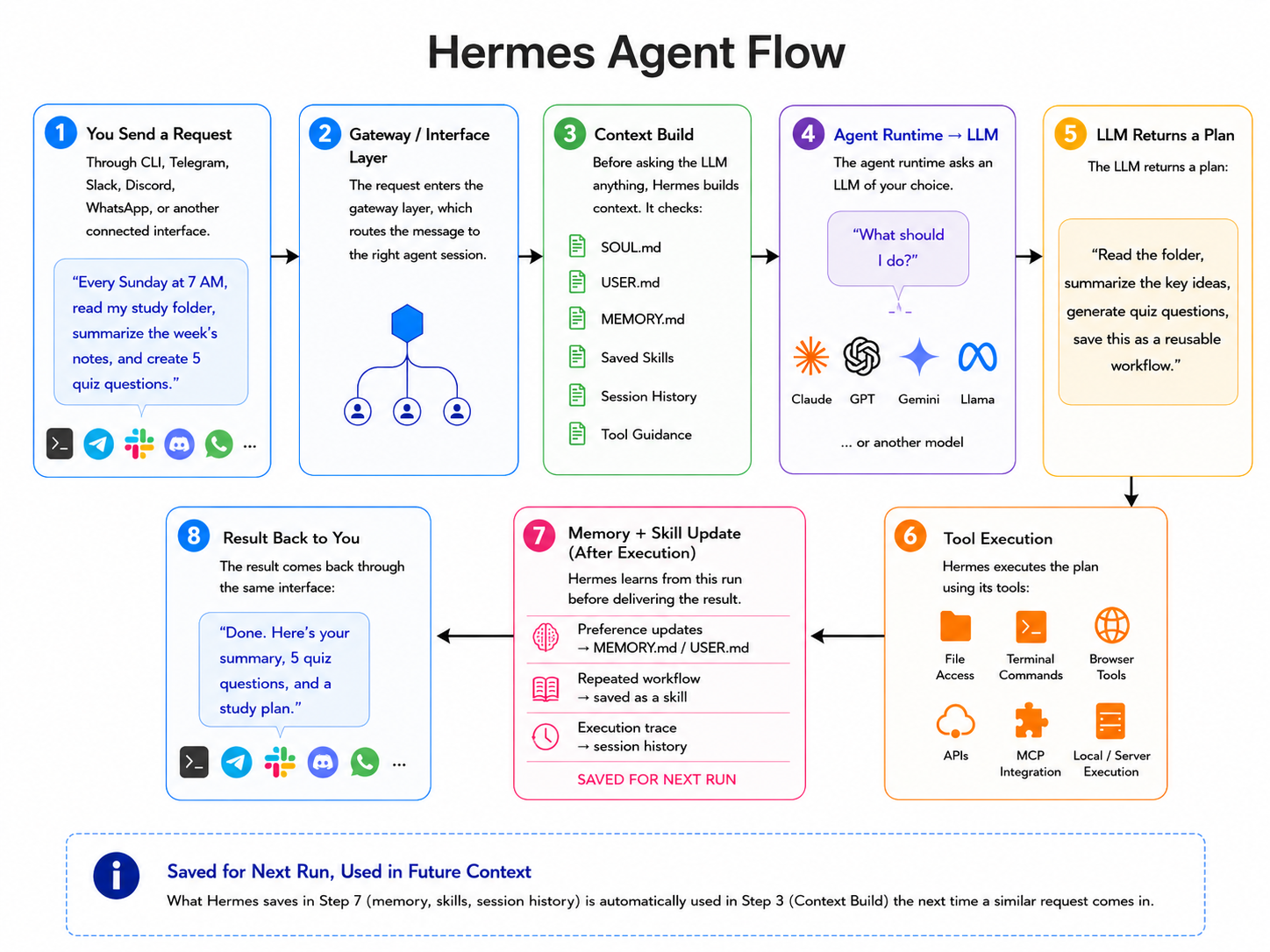
- You send a request through CLI, Telegram, Slack, Discord, WhatsApp, or another connected interface: "Every Sunday at 7 AM, read my study folder, summarize the week's notes, and create 5 quiz questions."
- The request comes through a connected interface or gateway and is passed to the Hermes agent session.
- Before asking the LLM anything, Hermes builds context. It checks files like SOUL.md (agent's personality), USER.md (who you are), MEMORY.md (what it learned), saved skills, session history, and tool guidance.
- The agent runtime asks an LLM of your choice — Claude, GPT, Gemini, or Llama — "What should I do?"
- The LLM returns a plan: read the folder, summarize the key ideas, generate quiz questions, save this as a reusable workflow.
- Hermes executes using its tools: file access, terminal, browser, APIs, MCP integrations.
- The result comes back through the same interface: "Done. Here's your summary, 5 quiz questions, and a study plan."
The key insight: Hermes is not just forwarding your message to an LLM. It first wraps your request with memory, identity, project context, saved skills, and tool instructions.
Memory is not the special part. Lots of agents have memory now.
What makes Hermes different is that after completing a complex task, it writes a reusable skill file automatically. Next time a similar task comes up, it does not start from scratch. It already has a playbook. The more you use it, the more it compounds around your actual work patterns.
The first week, Hermes creates the summary. Then you give feedback: "This was too long. Keep it under 5 bullets. Explain the concept before the quiz questions."
The next week, when you ask: "Do the same for physics."
Hermes does not start from zero. It remembers that you prefer short summaries, concept explanation first, 5 quiz questions, and a study plan at the end.
OpenClaw is strongest when you want to reach an agent across many messaging channels and control how it behaves.
Hermes is strongest when you want an agent to learn a repeated workflow and improve over time. That is the self-improving part.