Your AI demo can work perfectly. That still tells you very little about how it behaves in production.
You tweak a prompt. You run a few examples. The answers feel better. So you ship. That is fine for a prototype, but in production, that approach starts to break down. This is where evals come in.
Evals, short for evaluations, are structured tests that measure how well an AI system performs a specific task. Think of them like QA testing: they check reliability and catch regressions before your users do. The big difference is that AI systems are non-deterministic. They do not always give the exact same answer every time. Ask the same model to write a restaurant confirmation message twice and you may get two slightly different answers. So evals are built to measure quality even when the output is not exactly the same.
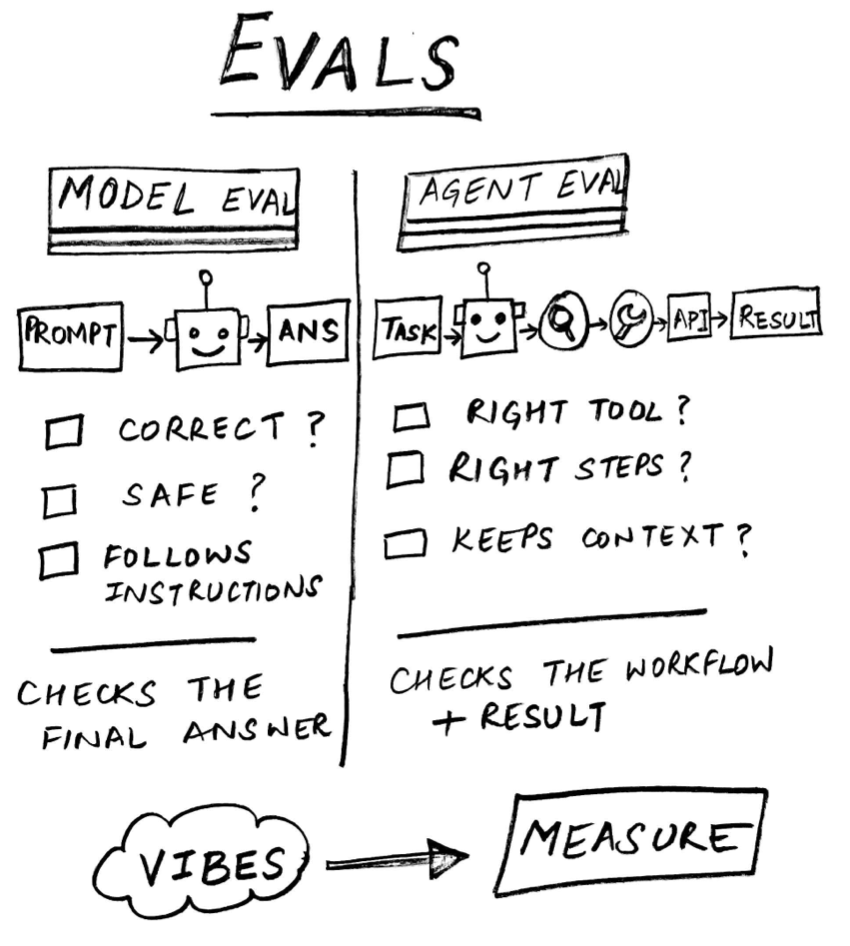
Model Evals
For models, evals usually grade the final answer. For example: a user asks the model to write a polite confirmation message for a table for 6 people at DishDash at 7 PM this Friday. A good model eval checks: Did it mention DishDash? Did it say 6 people? Did it include 7 PM this Friday? Was the tone polite?
Agent Evals
For agents, you have to go deeper. Agents call tools, retrieve information, hit APIs, update state, and make decisions across many steps. One wrong step can break the whole task.
For example: a user asks an agent to book a table for 6 people at DishDash at 7 PM this Friday. A good agent eval checks: Did it choose the right restaurant? Did it select the correct date and time? Did it book for 6 people? Did it use the right tool or API? Did it confirm only after the reservation was actually made?
Model evals check the answer. Agent evals check the answer and the path taken to get there. Evals are how teams move from guessing to measuring.